
Understanding Sexual Violence in Faith Communities: A Resource for Professionals Working with Youth
Understanding Sexual Violence and Working toward Prevention is a resource created by HEART and Maryam Mirza, and is partly adapted from a previous collaborative toolkit: Engaging Muslim Communities in Ending Sexual Exploitation. This paper is for groups within Muslim communities such as educators, school administrators, other mental health professionals and any other individuals who are committed to working to prevent sexual violence from plaguing our communities.
Tags: Allyship, Barriers to Reporting, Institutional Change, Sexual Violence 101
Religious Headwear: Protecting First Amendment Rights in Los Angeles County
HEART staff member Sahar Pirzada collaborated on this policy brief published by the Women’s Policy Institute. Highlighting the issue of religious headwear in LA County, this brief asks LA County to allow women to don religious headwear if they choose, thereby aligning with basic First Amendment rights. At HEART, we recognize the intersectionality of issues including Islamophobia, sexual violence, and gender inequality. Injustices must be addressed across the board for real social change to occur.
Tags: Advocacy, Gendered Islamophobia, Reproductive Justice
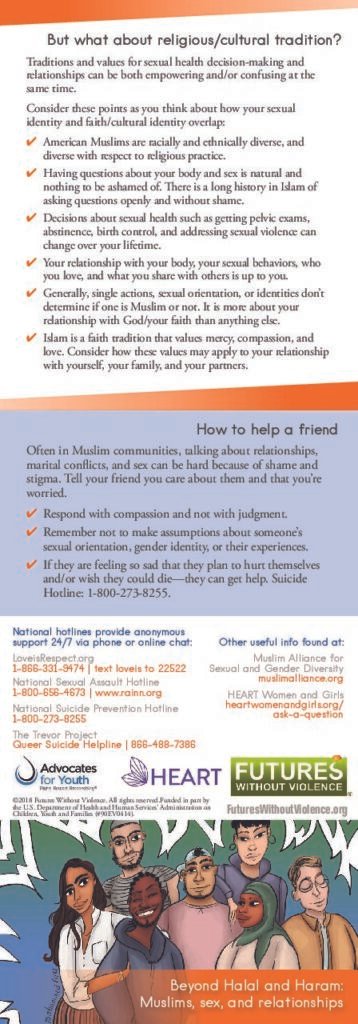
BEYOND HALAL AND HARAM: MUSLIMS, SEX, AND RELATIONSHIPS SAFETY CARD
The goal of this safety card is to be both a survivor-centered resource and a useful conversation starter for health care providers, counselors, social workers, mentors, or other adults working with high-school and college-aged Muslim youth who are doing universal education around healthy relationships and assessing for violence. The card provides information on healthy relationships and sex, guidance and resources for support, how to help a friend, and cultural and religious factors that play into decision-making.
Tags: Muslims & Sex Ed, RAHIM, Sexual Decision Making
Sex Education for Muslim Youth: Starting the Conversation
An introductory toolkit, this resource targets anyone interested in starting the conversation about sexual health with Muslim youth in a way that is mindful of the community’s cultural and religious values. Perfect for the individual who may not necessarily work with Muslim youth full-time, but still interacts with them on a regular basis, such as the Sunday School teacher, the youth group leader, or a committed parent. This toolkit raises awareness about why it is important to start speaking with Muslim youth about sexual and reproductive health, and offers some tips and strategies on how to begin those conversations in a way that is true to public health science and also aligned with the Islamic tradition.
Tags: Comprehensive Sex Education, Muslims & Sex Ed, RAHIM, Sexual Decision Making, Youth
Let’s Talk about Sex (Education): A Guide to Effective Programming for Muslim Youth
In this first-of-its-kind guide, educators and adult allies can learn what it takes to design a sexual health program for American Muslim young women and find useful steps on how to do so in a way that is accurate and comprehensive while still taking into consideration their cultural and religious context. Based on three years of fieldwork, this toolkit is a product of our pioneering sexual health peer education program for Muslim college women. This comprehensive guide includes information on current research and best practices, suggested components of a sexual health program geared toward Muslim youth, brainstorming worksheets for small group work, and much more!
Tags: Comprehensive Sex Education, Menstruation & puberty, Muslims & Sex Ed, RAHIM, Sexual Decision Making
Let’s Talk about Sex: The Muslim Parent’s Guide to “The Talk” with their Kids
This guide offers important background information and practical steps for parents who want to have conversations about sex, relationships, and expectations with their kids: either in addition to health education class in school, or in place of it. While we do promote a developmental approach and starting these conversations with children as young as 3, parents of pre-teens and teens may find this guide most helpful and relevant. This guide offers 4 easy steps through the acronym OPEN, which stands for: Openly Communicate, Provide Information, Encourage Questions, and Normalize Puberty & Sex. A must-read for all parents.
Tags: Comprehensive Sex Education, Menstruation & puberty, Muslims & Sex Ed, RAHIM, Sexual Decision Making